Tuesday, April 26, 2016

Kapotasana or Pigeon Pose: How to Safely Open the Hips

By Janine L. Agoglia

Pigeon Pose, or Kapotasana is a quintessential hip opener common in many yoga practices. For people who run, climb stairs or really do any type of physical exercise, the Glutes, or what we call the "hips" in yoga, can get very tight. This can lead to dysfunction in other parts of the body (knees, lower back, hip joint). By "Opening the Hips" you can release the tension and feel more comfortable in your daily life, as well as prevent compensation injuries from occurring.

For people with knee or hip problems (joint replacements, labrum tears, meniscus tears, etc.) I don't recommend Pigeon for you, however, there are other variations that can accommodate any body, and I will describe them in a bit.

Pigeon Pose (Kapotasana):

Come onto your mat and bring your right knee forward, placing it on the mat in front of your right hip, slightly toward your right hand. Aim both hip bones forward equally toward the wall in front of you ("squareing" the hips). Your left leg should extend directly behind your left hip with the knee facing the floor and the ankle extended. Feel free to place a blanket or pad under your left knee for some cushioning if you need. Take a deep breath in, and as you exhale, lengthen your spine forward to fold over your right thigh. Let your head rest on the floor in front of you and lengthen your arms forward. Stay 5-10 breaths then repeat with the left leg forward.

Key points for Pigeon:
  • Hips are squared forward
  • The hips do no not need to touch the floor
  • The head should rest on something
  • Your front knee should be aligned in front of your hip
  • Your shoulders should be relaxed and not holding you up
  • You must breathe


Hips are squared forward. This means that both hips face straight ahead, rather than aiming on a diagonal. When you fold forward over your front knee, both hips should be aiming for and be equidistant from the floor.


Your hips do not need to touch the floor. The tendency is to place the hip of the leg that is forward on the floor, but this actually reduces the hip stretch. Eventually (perhaps) both hips will reach the floor at the same time, but that is not the goal. The goal is to feel an opening in the hip of the leg that is forward. If it is uncomfortable to have the hips off the floor, place a block, blanket or bolster under that hip of the forward leg. Make sure to bring the support up to meet the hip, not the hip down onto the support, as this will throw off your alignment by "unsquaring" your hips.

Your head should rest on something. If your head doesn't reach the floor, you can rest it on a block or on your hands. When you relax your neck, your jaw can relax. When the jaw relaxes, it allows the hips to relax, which is what we are focusing on in this pose. Also, when the head can rest on something it allows you extend the arms forward and relax the shoulders.

Your front knee should be aligned in front of your hip. If your right knee is forward, place it in front of your right hip so that the thigh is parallel to the right side of your mat. You can increase the intensity of the hip stretch by moving your right shin forward toward being parallel to the front edge of your mat, or decrease the intensity by bringing your right foot back toward your left hip. The intensity should never by higher than a 7 on a scale of 1-10.


Your shoulders should be relaxed, not holding you up. Try not to rest on your elbows as this causes the shoulders to scrunch and creates tension in the neck. Try to extend the arms in front of you so that the shoulders and neck can relax.

You must breathe. As you exhale, there is a natural physiological response of relaxation. The deeper you inhale, the longer you can exhale and the more time you have to relax the hips. The best way to gain flexibility is to relax into a stretch, not to force it. By breathing deeply your hips will open gently as they are ready.

As I mentioned before, Pigeon is not for everyone. If you have knee or hip joint problems, there is a great alternate pose called Reclining Pigeon Pose.

Reclining Pigeon (Supta Kapotasana):

Lie on your back with your left foot flat on the floor and your left knee bent.
Take your right ankle and place it over your left knee. Bring your
left knee toward your left shoulder keeping your right foot flexed. Reach your right hand through the hole made by your right leg and hold your left thigh with both hands. Use arm strength to bring your left knee toward your left shoulder while lengthening your tailbone toward the floor and keeping your hips and legs relaxed. To deepen the stretch, use your right elbow to gently press your right thigh forward. Listen to your body and don't force anything. Again, the intensity should never be higher than a 7 on a scale of 1-10. To read more about knowing your limits in a yoga class, click here. Stay 5-10 breaths then repeat on the other side.

Janine L. Agoglia has been teaching Vinyasa yoga since 1998. Her yoga journey started in 1995 with Iyengar Yoga and she discovered Vinyasa yoga in 1997. The combination of breath with proper body alignment is what fuels Janine's practice and the classes that she teaches. She believes that yoga should be safe as well as challenging, creative and fun. She always emphasizes proper alignment within the flow, as well as focus, breath and humor to help students find the balance between strength and ease. Deepening one’s physical awareness helps one strengthen his/her spiritual awareness and mind-body connection. Janine loves being able to help people deepen their own practices, finding yoga in everyday life, on and off the mat. Her DVD, “Vinyasa Yoga for Regular People” is available for purchase at the front desk at Lumina Mind Body Studios in Wayland, MA.

In addition to being the Co-Director of Yoga and teaching yoga classes at Lumina Mind Body Studios, Janine is also a Licensed Acupuncturist and Chinese Herbalist who practices at Integrative Therapeutics in Natick, MA.

To contact Janine, please email acuyogamama@hotmail.com or visit her website, www.acuyogamama.com.


Sunday, April 17, 2016

To Roll or Not To Roll: Foam Rolling, Does it Help?

By Teresa Newton-Moineau

Have you ever seen those long black or white cylinders in the gym and weren't sure what they were? They are called Foam Rollers and should be an integral part of your exercise routine.

Foam rollers are important for recovery and injury prevention. They are most known and used by athletes but should be used by anyone who works out.  Foam rollers create a Self-Myofascial Release (SMR), which relaxes contracted muscles and fascia (a layer of connective tissue that surrounds the muscles of the body) through the force of the body against the foam roller. It is the next best thing to having a massage!

The benefits from using a foam roller include:
~Increased blood flow through the body
~Increase in circulation of blood and lymph, which promote healing
~Increased range of motion
~Better movement
~Known to help cellulite

There are various kinds of rollers, ranging from soft to hard.  You want to start off with one that is appropriate for your body so you will stick with it. If you don't feel anything, it is too soft; if you feel beaten up and bruised, it is too hard. The sensation can be strong while you are on the roller, but you should feel good after using it. You can roll almost every place on your body, with the exception of your stomach/chest area & on any organs. All of your muscles are fair game. However, if you have protruding varicose veins, please roll around them, not on them. Finally it is important to stay hydrated, not just for health, but because foam rolling will dehydrate you. It is a workout in and of itself!

If you want to see what the foam roller is all about, come try a class!  I teach Stretch, Roll & Sing every Saturday at 10:30am at Lumina Mind Body Studios in Wayland.


For over 35 years, Teresa Newton-Moineau has been teaching group exercise in the Metro-West area of Boston. With her understanding and passion for fitness, Teresa became a certified personal trainer in 1990, working with individuals for personal fitness success, as well as becoming a children's fitness specialist and conditioning coach for the local High School football team.

In 1996 Teresa became the Group Exercise Coordinator for the Longfellow Club in Wayland, MA. Teresa's legendary classes are held daily at the Longfellow Club and encompass Keizer Indoor Cycling, Step Aerobics, Muscle Conditioning, Pilates and Children's Fitness classes. Teresa is also certified in Nutrition, and is the creator of her  "Quick Fix" and "Stretch, Roll and Sing" classes, held exclusively at the Longfellow Club.

Saturday, April 9, 2016

Yoga Playground: An Exploration in the Practice of Yoga

By Erin Reilly

"I can't go to yoga class, I don't know how to do yoga!"
"I wish I felt comfortable asking a question in class."
"I'm curious about meditation and breathing exercises."
"I'm scared to go upside down."
"I've always wondered how to do ___________ pose."

Can you identify with any of these? The format of a regular yoga class, with its flowing series of poses like a moving meditation, can't often accommodate questions or deeply explore a pose. Though a flowing class can leave you in a deeply blissful state, there might be times when you leave feeling puzzled or questioning. Maybe you haven't been brave enough to even take a class!

Our new Lumina Natick class, Yoga Playground, which meets Mondays 11a-12p, offers the chance to learn yoga techniques within a class setting. It is appropriate for beginners through advanced students, since even the most advanced yogi can keep learning. It is often the most advanced students that have the most questions!

Would you ever say you can't take piano lessons because you don't know how to play the piano? Of course not; same with yoga-- you learn as you go! During class your teacher works with you on techniques, then you practice them. You can continue practicing your "yoga lessons" at home!

Each week at Yoga Playground, we will warm up with some flowing, breath-linked moves, then have fun exploring different areas of yoga, with time for demonstrations, questions and practice. We will always end with some delicious stretching and a wonderful relaxation.

Possible Topics (of course your suggestions are always welcome!):

  • Balance
  • Back bending
  • Arm balances
  • Building strength
  • Meditation
  • Yoga for Mood regulation
  • Breathing exercises
  • Going upside down (inversions)

The more you come, the more you will learn and before you know it, you will have a solid yoga practice!

Learning something new, especially something physical, is so good for your brain! Bring your open mind, your playful spirit, and your body, no matter what state it is in. 

Come play at the Yoga Playground!

Erin likes to combine the best of all that different yoga styles have to offer, into a class of creative flow, safe alignment, anatomical explanations and awareness of the mental benefits of yoga.

Erin began her yoga journey in 2001, right here at the Natick Longfellow Sports Club, taking classes with Janine Agoglia 3 times a week. Erin's background as a gymnast and hurdler prepared her well for yoga. Since then she has trained with many of the world's most famous yoga teachers (none better than Janine!), at the Kripalu Center in the Berkshires and in Boston.

Erin also teaches yoga and leads retreats at her waterfront home studio in Wellesley, Personal DAY Yoga. For more information about Erin and her classes, go to  www.personalday.net. 


Monday, March 28, 2016

Common Causes of Lower Back Pain and their Yoga Solutions

By Janine L. Agoglia

Back pain is very common. There is a statistic that says 80% of adults will experience back pain at some point in their lifetime. The most common cause of back pain comes down to one thing: posture. When your mother told you to stand up straight, she was right: as gravity pulls on our bodies day after day, hour after hour, if it is improperly aligned (like when you slouch), your muscles strain to move you toward vertical. Small stabilizer muscles overwork and eventually start to hurt. Long term incorrect posture can lead to more serious issues, like disc problems and debilitating pain. Before starting any exercise plan and to fully understand the nature of your back pain, it is important to get a full evaluation from a medical professional. To understand how posture affects pain, let's look at the lower back and pelvis.

Common causes of lower back pain can be tight hamstrings, tight hip flexors, weak core or all of the above. When you spend much of your time sitting, at a desk or in a car, your hip flexors and hamstrings are in a constant state of contraction. The longer you sit, the more likely it is for your muscles to tire and you start to slouch. Slouching causes the tailbone to aim forward, which shortens the hamstrings even more, as they attach to the base of the pelvis at the sit bones (ischial tuberosities). Long term tightening of the hamstrings and hip flexors puts strain on the lower back, which then has to compensate when you move. When the hamstrings pull on the sit bones, it brings the lower back out of the natural lumbar curve, causing a flattening of the lower back which weakens the muscles and they lose stability. Tight hip flexors cause the tailbone to aim backward which causes a deepening of the lumbar curve which can cause compression in the lumbar vertebrae and lead to lower back pain and disc problems. The Psoas muscles attach to the front lumbar vertibrae and will then pull and cause pain and misalignment of the lower back. Unfortunately having both tight hamstrings and tight hip flexors doesn't cause a net zero cancellation, but rather causes more problems. When you have a weak core (which includes the hip flexors, abdominals, pelvic floor and lower back muscles), the lower back is overused and can often strain. Strengthening the core can make a huge difference in your back pain.

So what to do? Step one is to work on your posture. How you use your body for the majority of your day matters more than just doing a few poses. If you can work to prevent the problem in the first place, all the better. Think about stacking your joints whether you are sitting or standing. The more awareness you have surrounding how you sit and stand plays a huge part in how your body feels and functions.

In terms of addressing the hamstrings and hip flexors, there is a lot that can be done to improve how they affect the pelvis, and therefore your lower back. It is important to understand where these muscles attach, so that you are better able to stretch them and get the pressure off of your lower back.

The Hamstring muscle group is made up of 3 muscles that attach at the sit bone and the lower leg so that your knee can bend. Contracting the hamstrings bends the knee, they stretch and elongate when the leg is straightened; the tighter this muscle group is, the harder it is to straighten the leg. When hamstrings are chronically tight, it is common for the lower back to stretch instead, or take the brunt of the force that belongs in the legs. For example, when you fold forward over your legs, ideally you are moving the sit bones away from the heels to stretch the hamstrings, but if they are tight, the lower back may round (keeping the sit bones closer to the heels), so that lower back takes the brunt of the stretch. You feel like you are folding forward, but you are not targeting the muscles that really need to stretch. Over time, the lower back gets stretched out, but not the hamstrings so they pull on the sit bones which throws off your posture and you end up with lower back pain.


The hip flexors include the Psoas and Iliacus muscles which together are the Iliopsoas group. These muscles attach to the vertibrae and Iliac bones (of the pelvis) and connect down to the Femur (upper leg). When they contract they bring the thigh toward the chest (flexing the hip) and when the hip extends, they lengthen. When these are tight, it makes it hard to bring the pelvis to a vertical alignment when you are standing. If your core is also weak it may create a deeper lordosis in the lower back (an increasing of the natural lumbar curve) which can compress the spine and vertebral discs and cause pain.


Working on the hamstrings and hip flexors should be a daily or every other day endeavor if you want to make a meaningful difference. As I wrote earlier, you are trying to undo posture habits that occur all day long every day, so every little bit helps. When you are stretching, it is important not to over stretch or force your body to open when it isn't ready. On a scale of 1-10, where 10 is excruciating pain and 1 is nothing, the stretch should create a sensation between 3-7. Make sure you are breathing deeply and slowly so that the opening is gradual and with ease. Forcing a stretch where you are fighting yourself will only lead to injury. The deeper you breathe, the more you relax and the easier it is for the body to open.

When stretching the hamstrings it is important to focus on moving the sit bones away from the heels; at first the legs might not straighten all the way and that is fine. Place your left knee on the floor under your left hip and extend your right leg in front of you, foot flexed with the toes aiming for the ceiling. If getting down on the floor is challenging, you can stay standing and just place your foot on a step or stool in front of you. Have a chair or wall handy to rest your hands upon. With your right leg extended, tip your pelvis forward so that the sit bones move away from your right heel. Place your hands on the floor or blocks on either side of your right leg (or on a chair or wall if you are standing). Stay for 5-10 deep, slow breaths, then repeat to the other side.


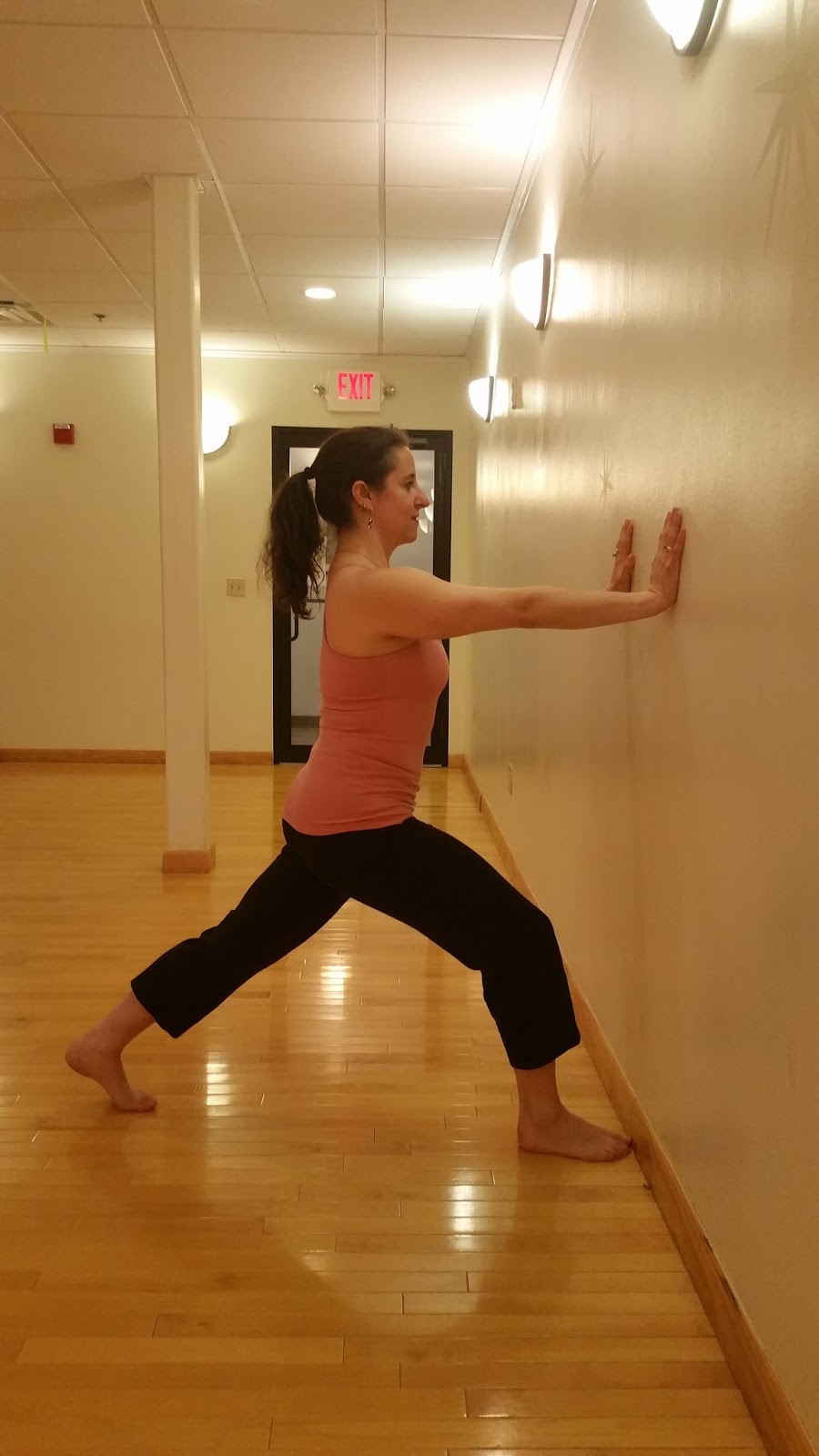
When stretching the hip flexors, start in the same position on your left knee with your right leg extended. Bend your right knee until the knee is over your right ankle and place your hands on the floor or on blocks on either side of your right foot. You can stay there if you are already feeling a stretch in front of your left hip, or you can place your hands on your right knee, bringing yourself more vertical, or raise your arms over your head if that feels comfortable. If the floor is not available stand facing a wall with your right foot at the wall and your left foot about 2-3 feet behind your left hip. Stand on the ball of your left foot, place your hands on the wall and bend your right knee over your right ankle, keeping the pelvis as vertical as possible. If you don't feel a stretch, step your left foot further back. Whichever variation you choose, stay for 5-10 deep, slow breaths then repeat to the other side.

The best change is gradual. You can't undo years of misalignment in a week. Give your body time to change by stretching daily and being patient and compassionate with yourself.

Janine L. Agoglia has been teaching Vinyasa yoga since 1998. Her yoga journey started in 1995 with Iyengar Yoga and she discovered Vinyasa yoga in 1997. The combination of breath with proper body alignment is what fuels Janine's practice and the classes that she teaches. She believes that yoga should be safe as well as challenging, creative and fun. She always emphasizes proper alignment within the flow, as well as focus, breath and humor to help students find the balance between strength and ease. Deepening one’s physical awareness helps one strengthen his/her spiritual awareness and mind-body connection. Janine loves being able to help people deepen their own practices, finding yoga in everyday life on and off the mat. Her DVD, “Vinyasa Yoga for Regular People” is available for purchase at the front desk at Lumina Mind Body Studios in Wayland, MA.

In addition to being the Director of Yoga and teaching yoga classes at Lumina Mind Body Studios, and on Facebook,  Janine is also a Licensed Acupuncturist and Chinese Herbalist who practices at Integrative Therapeutics in Natick, MA.


Saturday, March 12, 2016

Downward Dog: Tips to Help You Love this Pose

By Janine L. Agoglia

Downward Facing Dog (Adho Mukha Svanasana) is a quintessential yoga pose practiced in most styles of yoga. It is a pose that can be used to warm up the body, strengthen the body and rest the body, depending on when it is done during the course of a yoga session. Once you understand how Downward Dog is done properly, any "loather" can become a "lover" of this pose.


Ideally the final shape of Down Dog should be an upside down "V", but there is a lot that the body needs to do in order for that to happen.

Flexibility and Strength

Downward Dog requires and creates flexibility in the hamstrings (muscle group on the back of the thighs) and the shoulders, while simultaneously requiring and creating strength in the shoulders, upper back, core and legs. When done properly, Downward Dog uses and opens the whole body at once. The more you utilize the whole body, the less any one body part has to work. Eventually this pose is comfortable and relaxing. If you struggle with Downward Dog, read on to learn the basics.

The Basics

Start on your hands and knees, placing your hands right under your shoulders. Spread your palms wide on the floor with your middle fingers parallel to each other. Spin your inner elbow creases forward so that if you bent your elbows they would point toward your thighs. Spread your shoulder blades apart and slide them toward your waist. Tuck your toes under and lift your hips bringing your body into an upside down "V." Make sure that you haven't let your shoulders shrug, see if you can keep your shoulders wide.

Try to keep your spine as straight as possibly, maintaining the lumbar (lower back) curve that you have when you are standing. If your hamstrings are tight, chances are that your lower back has rounded and your tailbone is pointing toward the floor. Ideally your sit bones (at the base of your pelvis) are aiming in a diagonal line away from your palms. To modify for tight hamstrings, keep your knees bent so that you can actively reach your sit bones away from your palms while keeping the neutral lumbar curve.

Reach your inner thighs toward the wall behind you, taking some of the weight out of your arms and moving it into your legs. Heels actively reach toward the floor; if the heels come easily to the floor, move your feet back a bit so that you can more easily activate the heels. Feet should be parallel, with the heels located behind the second and third toes of each foot.

Hold Downward Facing Dog for 3-10 breaths, then rest in Child's Pose.


Troubleshooting

1. My wrists hurt in Down Dog:
--> Make sure your palms are flat on the floor, with every knuckle of the palm pressing downward. As you rotate your elbow creases to point more forward (most likely they won't be directed straight forward, but more diagonally toward each other), the tendency is to release the knuckles of the index fingers and thumbs from the floor. By pressing your palms flat it takes the pressure off the wrists and distributes the weight more evenly through the hand.

2. It's too much weight in my arms and shoulders:
--> The more you use your legs, the less your arms have to work. Try to extend your sit bones actively away from your palms. Place a block between your thighs and try to press the block toward the wall behind you. This will help you engage your legs more and get the weight out of your arms.

3. My neck hurts:
--> Try to relax your neck and let your head just hang down toward the floor. The more your spread your shoulders apart and connect your shoulder blades toward your waist the less strain in the neck. Keeping your eyes aimed toward your ankles can help. 

4. I can't get my heels to the floor:
--> No worries. As long as you can reach your heels toward the floor, it doesn't matter whether they touch or not. You will feel a nice stretch through your calves.

5. I can't straighten my back:
-->Keeping your knees bent takes the hamstrings out of the equation and makes it easier to flatten your spine. Over time, as the hamstrings lengthen, it will be easier to both straighten the legs and the spine.

To learn more about Downward Dog, as well as Plank, Chaturanga and Upward Facing Dog, come to my workshop,  Vinyasa 101 on March 26th from 12-2p at Lumina Mind Body Studios in Wayland.

Janine L. Agoglia has been teaching Vinyasa yoga since 1998. Her yoga journey started in 1995 with Iyengar Yoga and she discovered Vinyasa yoga in 1997. The combination of breath with proper body alignment is what fuels Janine's practice and the classes that she teaches. She believes that yoga should be safe as well as challenging, creative and fun. She always emphasizes proper alignment within the flow, as well as focus, breath and humor to help students find the balance between strength and ease. Deepening one’s physical awareness helps one strengthen his/her spiritual awareness and mind-body connection. Janine loves being able to help people deepen their own practices, finding yoga in everyday life on and off the mat. Her DVD, “Vinyasa Yoga for Regular People” is available for purchase at the front desk at Lumina Mind Body Studios in Wayland, MA.

In addition to being the Co-Director of Yoga and teaching yoga classes at Lumina Mind Body Studios, Janine is also a Licensed Acupuncturist and Chinese Herbalist who practices at Integrative Therapeutics in Natick, MA.
To contact Janine, please email acuyogamama@hotmail.com or visit her website, www.acuyogamama.com.

Sunday, February 28, 2016

How to Love Your Body--A Body Story

Reprinted with permission from the blog A Body Story, written by Holly Kania.

Day 6: Why A "Body Story?"


That old saw: “write what you know.” I am still coming to know my body and our relationship has surely had interesting narrative turns. But as a Nia teacher, and now adding work with movement-challenged populations as an Ageless Grace educator, I am fascinated by my students’ relationships to their body stories–how they move, why they wince, the moments when they transcend themselves and I can literally see their souls moving underneath their flesh.
My students constantly surprise me. They are mostly women, typically between their late-forties and seventy years in age. They come to class for a variety of reasons, but mostly because they like the music and they love to dance. I’ve had a lot of different jobs in my life, but never one like this, where it daily feels like a privilege to be among them, to bear witness as they learn new steps or try new skills, often moving through pain or limitation. And whether by nature they are creaky and off-tempo or limber and rhythmic just doesn’t matter. I can see something of their struggle in life in how they move, in which movements or songs call them out of themselves and unlock their younger selves – transforming achy or self-conscious idiosyncracies into sudden bursts of playfulness, freedom or sensuality. Each of their bodies tells a story: I had colon cancer when I was in my fifties; here I am, dancing. Take that! I had breast cancer ages ago but that was child’s play compared to Parkinson’s; I’m just glad to be alive. I was a competitive ice dancer; now spinning makes me dizzy. I’ve always been a klutz, but I don’t care; look at me shakin’ it! I played three sets of tennis yesterday morning and another two last night; bring it on. I’ve been trying to lose these 10/20/30/40 pounds for the last 1/5/10/15 years; I feel beautiful when I dance. I haven’t slept well for the last year; this stretch feels so good.
Life in the physical body can be a pretty tough business. For some people, it’s a sh*t-storm of pain and frustration; for others, it’s the slow drip of diminishing returns. The luckiest among us may live pain and disease free, may even glory in good health, but we still find plenty to complain about. And yet, for all of us, there is joy to be had. That’s a body story.

 A certified Brown Belt instructor in Nia Technique, Holly has taught Nia classes in Metrowest Boston for four years, and has been teaching at Lumina since January 2013.  Holly did her Nia certification trainings in Concord, MA with Maria Skinner & Al Wright (White Belt), Sun Valley, ID with Britta von Tagen & Casey Bernstein (Blue Belt) and Houston, TX with Helen Terry (Brown Belt).  She plans to pursue her Black Belt certification (the highest level in Nia teacher certification) in 2016.  She is thrilled to share this movement practice with the clients at Lumina.


Friday, February 12, 2016

Backbends: The Fountain of Youth?


By Janine L. Agoglia

Back bending poses are a core part of most asana practices, whether they are small and controlled like Cow pose or Cobra, or more dynamic, like Camel, Dancer or King Pigeon. Back bending poses not only look good, but they create spinal flexibility and back strength, as well as undo the effects of gravity on our body. When you imagine a stereotypical "old person" they are typically slumped forward with a rounded upper back, leaning on a cane. A stereotypical "young person" has a more vertical posture and ease of movement. The secret to a youthful appearance are poses that reverse the effects of gravity on the body, helping you stand more upright.

From the moment we learn to stand up, gravity begins pulling us forward and downward. This is only exacerbated by poor attention to posture, driving, sitting at a computer, taking notes in school, texting and holding small children. Unless you work to reverse it, gravity causes the head to fall forward which creates strain in the neck and upper back muscles, and tightens the chest muscles; the tailbone tucks forward, thereby tightening the hamstrings and weakening the hip flexors and lower back. This causes them undo strain. By letting gravity win on a daily basis you are left with physical limitations, dysfunction and eventually pain. Poor posture has also been linked to heart disease, poor lung function, poor circulation and headaches.

Back bends help us reverse the effects of gravity on the body by moving us in the other direction. By opening and stretching the front of the body, the back muscles intentionally contract making them stronger; it is weak muscles that strain since they are forced to work harder than they are capable. There are many safe and fun ways to back bend that work for every body. Here are just a few examples from simple and supported to more advanced and strengthening:


Supported Reclining Bound Angle

Supported Bridge


Supported Reclining Bound Angle and Supported Bridge are two great back bending poses that are gentler and use gravity to create the opening.


         Cobra with arms extended

For a more active back bend, Cobra is a great place to start. Create the pose using the muscles of the back, rather than the arms. This variation really encourages the squeezing of the shoulder blades and activation the muscles along the spine. Make sure to lengthen the tailbone toward the floor and press the feet into the floor so that it is an upper back backbend.


Upward Facing Dog
To take it up a level, take Cobra off the floor into Upward Facing Dog. Keep the tailbone reaching for the floor, but lift the legs off the floor so that the only things pressing into the floor are the hands and feet. Press the shoulder blades down through the palms and make sure the shoulders are over the wrists. The more you use your legs, the better, and again, it is an upper back backbend.


For more experienced practitioners, Wheel and Camel can feel really good. As with all back bends, keep lengthening the tailbone forward and use the legs!

Wheel

                                                        
                                                                                                              Camel

After all back bending practices it is good to counterbalance with some easy forward bends and gentle twists. Lie down on your back and pull your knees into the chest, maybe lift your head toward your knees. Then bring your head back to the floor and let your knees fall to the left as you look to the right. Stay for a few breaths then do the other side.


Janine L. Agoglia has been teaching Vinyasa yoga since 1998. Her yoga journey started in 1995 with Iyengar Yoga and she discovered Vinyasa yoga in 1997. The combination of breath with proper body alignment is what fuels Janine's practice and the classes that she teaches. She believes that yoga should be safe as well as challenging, creative and fun. She always emphasizes proper alignment within the flow, as well as focus, breath and humor to help students find the balance between strength and ease. Deepening one’s physical awareness helps one strengthen his/her spiritual awareness and mind-body connection. Janine loves being able to help people deepen their own practices, finding yoga in everyday life on and off the mat. Her DVD, “Vinyasa Yoga for Regular People” is available for purchase at the front desk at Lumina Mind Body Studios in Wayland, MA.

In addition to being the Co-Director of Yoga and teaching yoga classes at Lumina Mind Body Studios, Janine is also a Licensed Acupuncturist and Chinese Herbalist who practices at Integrative Therapeutics in Natick, MA.

To contact Janine, please email acuyogamama@hotmail.com or visit her website, www.acuyogamama.com.